Storm Buckets Now Has Live Audit Logs for Full Visibility
Ownership without visibility is just access. Every request that touches your bucket now appears in your dashboard in real time - the operation, the object, the IP, the timestamp.
Most Canadians assume that when they save a file to the cloud, they own it. In a narrow sense, that's true - you can download it, delete it, share it. But ownership without visibility is just access. Storm Buckets gives you the other half.
Every request that touches your bucket now appears in your dashboard in real time - the operation, the object, the IP, the timestamp. Nothing aggregated, nothing delayed.
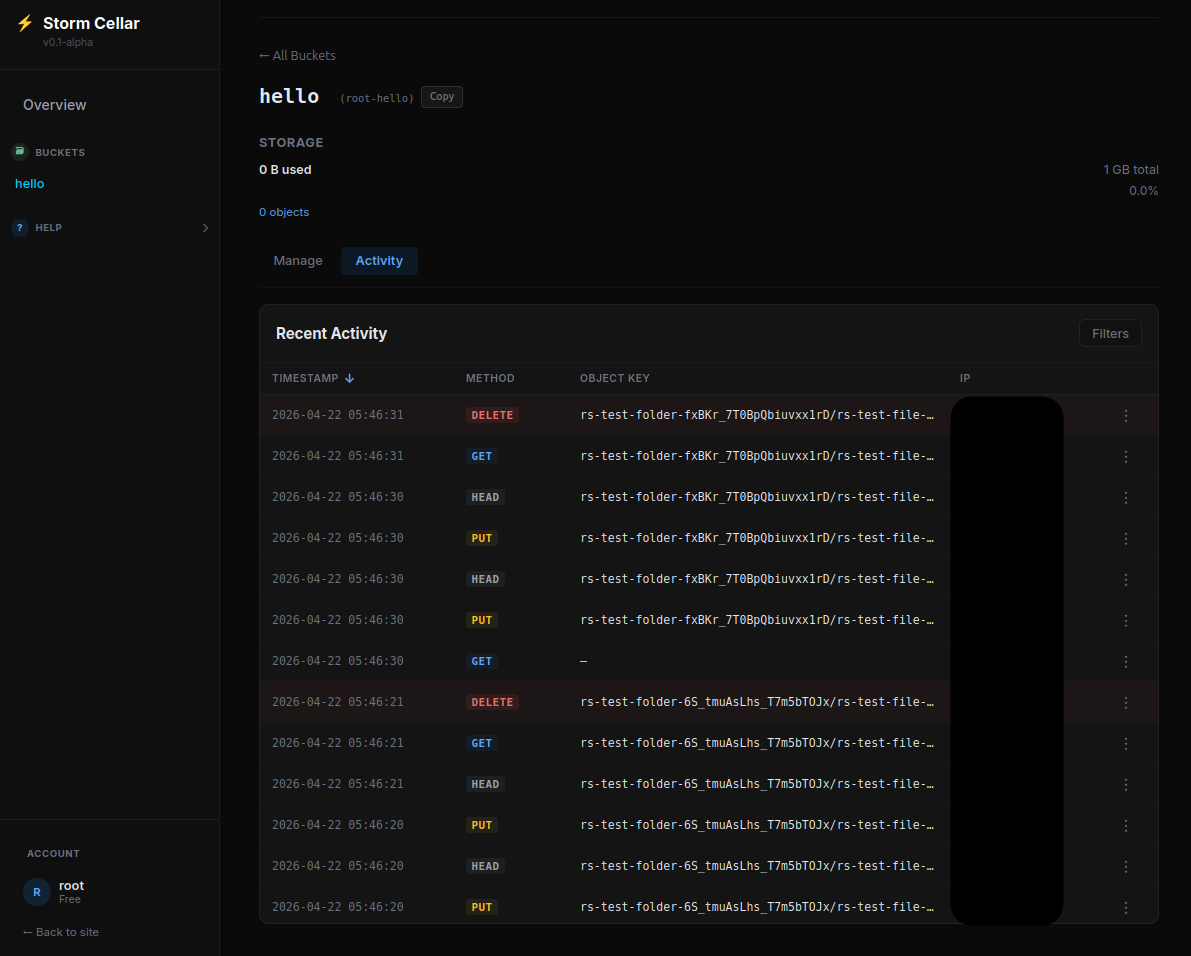
Here is what that looks like in practice. This is a real sync from Obsidian's Remotely Save plugin hitting a Storm Buckets bucket — every PUT, HEAD, and GET logged as it happened. If you're not familiar with what PUT, HEAD, and GET mean, we wrote a plain-English breakdown of the S3 protocol - how it works, what each operation does, and how to use it in your own apps.
What transparency actually looks like
Most cloud providers will tell you your data is safe, secure, and private. We think you shouldn't have to take anyone's word for it.
Every request that hits your bucket is logged with the operation, the object it touched, which access key made the request, the IP it came from, and when it happened. If something unexpected shows up - a GET you didn't make, an IP you don't recognize — you see it immediately.
This is powered by Storm Pulse, our open source server management agent. It ships logs from the storage nodes to your dashboard in real time — parsed, structured, and yours to read.
Built in Canada, built to last
Storm Buckets runs on Canadian hardware in Montreal. Your data doesn't cross the border, doesn't touch American infrastructure, and isn't subject to American court orders. That's not a marketing claim - it's a geography fact.
And because Storm Buckets is built on Garage, an open source S3-compatible server, every byte you store is portable. If you ever want to leave, you can. Same protocol, any provider. No lock-in.