The Anatomy of an AWS Surprise S3 Bill - A Canadian Alternative
The surprise on an AWS S3 bill is almost never storage. It is egress, the charge to pull your own data out, and the Canadian AWS region costs more without buying sovereignty. The math, and a Canadian S3 alternative priced in flat blocks.
The number that lands on your invoice is not the number on the pricing page. The surprise is almost never storage. It is egress, the charge to get your own data back out, and it is the line nobody forecasts.
Here is what an AWS S3 bill actually looks like when you move data, why a cheaper storage class does not save you, why the Canadian region makes it worse, and what two flat promises look like instead, each one tied to a mechanism you can check yourself.
Storage is the small half
S3 Standard storage is $0.023 per GB per month in US East (N. Virginia), AWS's cheapest region. That is the number you plan around. It is also the small half of the bill.
Take an ordinary workload: 5 TB of backups, sitting in a bucket for a month, downloaded once. A migration, a restore, an audit, an app that serves the files. AWS bills storage in binary gigabytes, so 5 TB is 5,120 GB.
-
Storage: 5,120 GB x $0.023 = $117.76
-
Egress: the first 100 GB out is free, then $0.09/GB. (5,120 - 100) x $0.09 = $451.80
-
Requests: negligible at this object size, under a dollar.
Total: about $570 for the month. Egress is 79% of it.
You stored 5 TB and paid $118 to keep it. You read 5 TB once and paid $452 for the privilege. The line you can forecast is the one that barely moves. The line that moves is the one no calculator shows you until the data is already on the wire. (These are AWS's published us-east-1 rates applied to a stated workload, not a leaked invoice. Run the numbers yourself; that is the point.)
Now flip the workload. Store 1 TB but serve it hard, a media bucket, a busy restore month, pulled five times over: 1 TB stored, 5 TB out.
-
Storage: 1,024 GB x $0.023 = $23.55
-
Egress: (5,120 - 100) x $0.09 = $451.80
Total: about $475. Egress is 95% of it. The storage line is a rounding error. You are not paying for what you keep. You are paying for what you read.
A cheaper storage class does not fix this
The reflex is to reach for Glacier. It is the wrong lever, because egress is charged the same no matter which class the data sits in.
Move that 5 TB to Glacier Deep Archive at $0.00099/GB and storage drops to about $5. A real saving on the line that was already small. Then you retrieve it: a per-GB retrieval fee on top, plus the same $452 of egress to get it off AWS entirely. Once retrieval is added, a download-once workload on Glacier can cost more than it did on Standard, and Deep Archive holds you to a 180-day minimum, so deleting early triggers its own penalty.
Cheaper classes shrink the part of the bill that was never the problem. The egress meter runs at the same rate regardless.
The Canadian region is the worst trade in the catalogue
Every figure above is us-east-1, AWS's cheapest region. There are two AWS regions in Canada, Central (Montreal) and West (Calgary), and a Canadian buyer reaches for one of them for the obvious reason: keep the data in the country.
In both Canadian regions, S3 Standard is $0.025 per GB, against $0.023 in Virginia. You pay about 9% more on storage for the privilege, and the egress meter is still running underneath it.
Here is the part that matters more than the 9%. The Canadian region buys you lower latency to Canadian users. It does not buy you sovereignty. AWS is a US company, and the US CLOUD Act reaches a US company's data wherever the data center sits. A court order served on Amazon reaches your bytes in Montreal exactly as it reaches them in Virginia. The data center's coordinates are not the question; the operator's jurisdiction is. So the Canadian-region customer pays more, gets faster throughput, and the one thing they were likely buying, data beyond US legal reach, is not in the box.
Storm Buckets: the two promises
Storm Buckets is S3-compatible object storage, hosted in Canada, operated by a Canadian company. It runs on Garage, an open-source storage engine you can read in full. We do not fork it or wrap its source; the engine under your bytes is public. That is the ground both promises stand on, neither is a slogan, each is a mechanism you can verify.
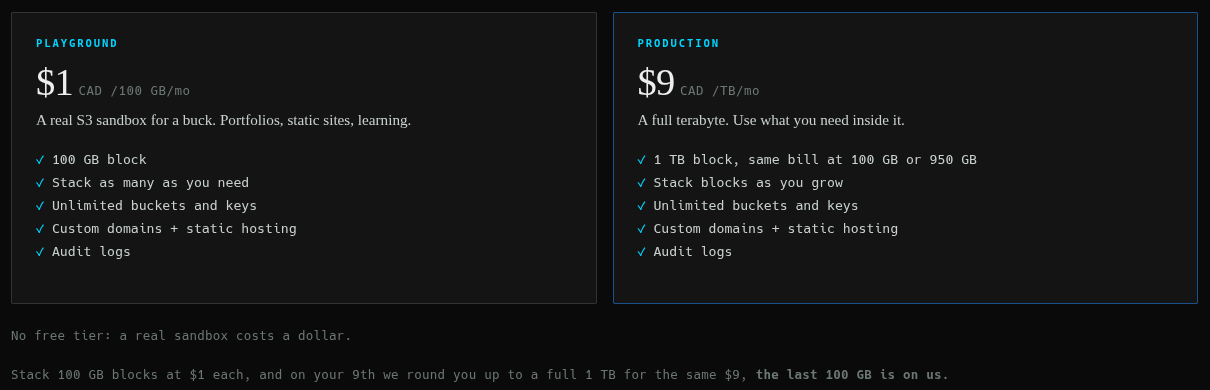
No surprise bill. Storage is a flat block, $9 CAD per terabyte, and your egress allowance is 3x your stored capacity each month. Cross it and reads throttle; they are never billed and never stop your writes. The 1 TB media bucket that cost $475 on AWS is $9 here. A heavy month slows your reads instead of mailing you an invoice, and you can see it coming: every account watches its egress against the allowance in a real-time audit log, so the number that governs your bill is one you read as it accrues.
No lock-in. AWS's egress fee is itself a soft cage; the same $0.09/GB you pay to read is what leaving costs, so the exit is expensive by design. Storm speaks the S3 API over an open engine, so the rclone command that moved your data in moves it out, no export ticket, no exit fee. Because the engine is Garage and not a proprietary dialect, the door in is the door out, and you can read the source to confirm it.
Where this goes next
Pricing, blocks, and the egress allowance are laid out in full on the Storm Buckets pricing page. If you want the wider Canadian landscape, including the other providers that drop the egress meter and how they compare on jurisdiction and lock-in, that is the Canadian S3 alternative buyer's guide, competitors and real numbers included, written in the open.
Storm Buckets is Canadian-hosted, Garage underneath, and every operation on your account is audit-logged and visible in real time. If the egress meter is the reason your data feels stuck, request alpha access.
100% Canadian Hosted.